Intel Stock in 2025–2026: From Turnaround Hopes to Strategic Inflection Point
In the semiconductor sector, Intel (NASDAQ: INTC) has had one of the most notable and talked-about years. The company’s stock trajectory over 2025–early 2026 tells a tale of structural change, significant collaborations, short-term volatility, and longer-term existential stakes following years of underperformance, skyrocketing costs, and market share loss to competitors like Nvidia (NASDAQ: NVDA) and AMD (NASDAQ: AMD). Nasdaq
A Rough End to 2025, but With a Twist
The year-end picture didn’t look good at first: in the holiday-thin trading session prior to New Year’s Day, Intel’s shares actually closed 2025 down. (TechStock)
But the deeper story is not conveyed by this headline.
Even though 2025 ended slowly, it was a year of significant stock fluctuations and important strategic advancements, and it left Intel in a very different position than it was at the beginning. Investors and analysts concluded the year concentrating on actual 2026 catalysts rather than headlines. (TechStock)
Big Backers: Nvidia and the U.S. Government
Two unconventional — and powerful — themes drove sentiment around Intel:
1. Nvidia’s $5 Billion Stake
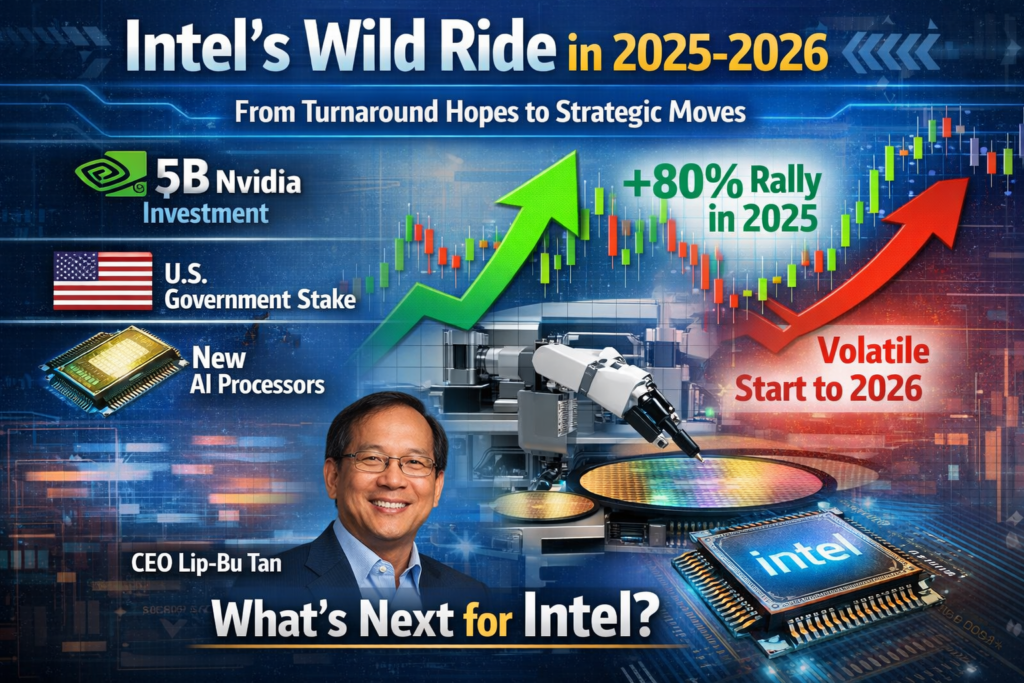
In one of the most surprising semiconductor stories of recent years, Nvidia took a $5 billion equity stake in Intel through a private placement. (Yahoo Finance) This investment wasn’t just cash — it signaled a validation of Intel’s roadmap and manufacturing potential from one of the world’s most successful chipmakers.
Markets interpreted this as a bullish vote of confidence. The transaction has:
- Put fresh cash on Intel’s balance sheet.
- Allowed Nvidia to integrate more tightly with Intel’s X86 ecosystem (a strategic plus for both). (Wikipedia)
- Reinforced Intel’s narrative of being central — not irrelevant — in the future AI-driven compute stack.
2. Government Stake and Chips Act Support
Intel also secured a nearly 10% equity stake from the U.S. Treasury last year under the CHIPS and Science Act framework — part of federal efforts to keep semiconductor manufacturing onshore. (MarketBeat)
This isn’t the kind of support that comes with no strings: government oversight on spending and programs is now part of the picture. But for a company that once teetered close to obsolescence in investors’ eyes, it means institutionalized backing, not just momentary speculation. (MarketBeat)
2025 Rally: Why Shares Soared 80%+
Despite ending the year slightly lower than some hoped, Intel stock climbed more than 80% in 2025 thanks to these developments and major operational shifts. (Nasdaq)
Key drivers included:
✔ New leadership and cost discipline. CEO Lip-Bu Tan took over in March 2025 and quickly cut costs, prioritized cash flow, and refocused core business units. (Nasdaq)
✔ Strategic deal flow. The Nvidia investment, SoftBank and U.S. government placements strengthened Intel’s finances and strategic options for growth. (Nasdaq)
✔ Shift in investor narrative. Intel moved from being a “zombie stock” to a turnaround play with concrete catalysts. (Nasdaq)
Those headlines matter because the semiconductor industry is inherently cyclical and confidence-driven. Once that narrative flips, it attracts capital, partnerships, and opportunity — even if profits lag. (Nasdaq)
Volatility and Short-Term Trading Signals
In early January 2026, Intel shares experienced sharp intraday swings, moving significantly higher early in trading before retracing much of those gains. (The Motley Fool)
This kind of volatility can be confusing, but it usually reflects:
- Macro risk appetite, especially in tech and AI sectors.
- Headline-driven trading, where geopolitical events or product announcements temporarily sway sentiment.
- Ongoing skepticism about execution. Not all investors believe Intel’s turnaround can deliver on the promise — at least not quickly. (The Motley Fool)
What’s clear is that Intel is no longer ignored; it’s a stock that reacts aggressively to new information, which is very different from how it traded in the prior decade.
2026 — What to Watch
Here’s where this story gets interesting:
Product Roadmap
Intel recently announced its next-generation AI-centric PC processor lineup built on its advanced 18A process (expected to roll out in late January). (Investing.com Canada)
This lineup aims squarely at AI-optimized personal computing and productivity — and it matters because it shows Intel isn’t waiting for miracles; it’s delivering technology that can capture real market share.
Foundry Business Potential
Intel’s foundry efforts (manufacturing chips for other companies) are central to its future. Winning contracts here — especially around AI accelerators — could reshape profitability prospects.
Geopolitics and Supply Chain Shifts
As global tensions reshape where chips are made and who’s trusted to make them, Intel’s position as a U.S.-based manufacturer could be a competitive edge investors continue to price in.
Execution vs. Expectations
The biggest risk is not the lack of opportunity — it’s whether Intel can execute fast enough. Markets tend to price hopeful futures before profits arrive. That’s great for volatility, not always so great for conservative investors.
Bottom Line
Intel’s stock in late 2025–early 2026 tells a story far richer than “down vs. up.”
Yes, shares ended the year modestly lower. (TechStock²)
But the longer-term narrative has shifted from decline to dynamic repositioning:
- Big strategic capital from Nvidia and the U.S. government. (Yahoo Finance)
- Massive rally in 2025 driven by industry confidence. (Nasdaq)
- New products and potential foundry leadership on the horizon. (Investing.com Canada)
For investors, Intel has gone from a forgotten legacy name to a beta-rich play on structural change in chips, AI, and supply chains — and that’s exactly why traders are watching every headline.