How Google’s Jaana Dogan Ignited a Viral Tech Debate When AI Did in 1 Hour What Took Humans a Year
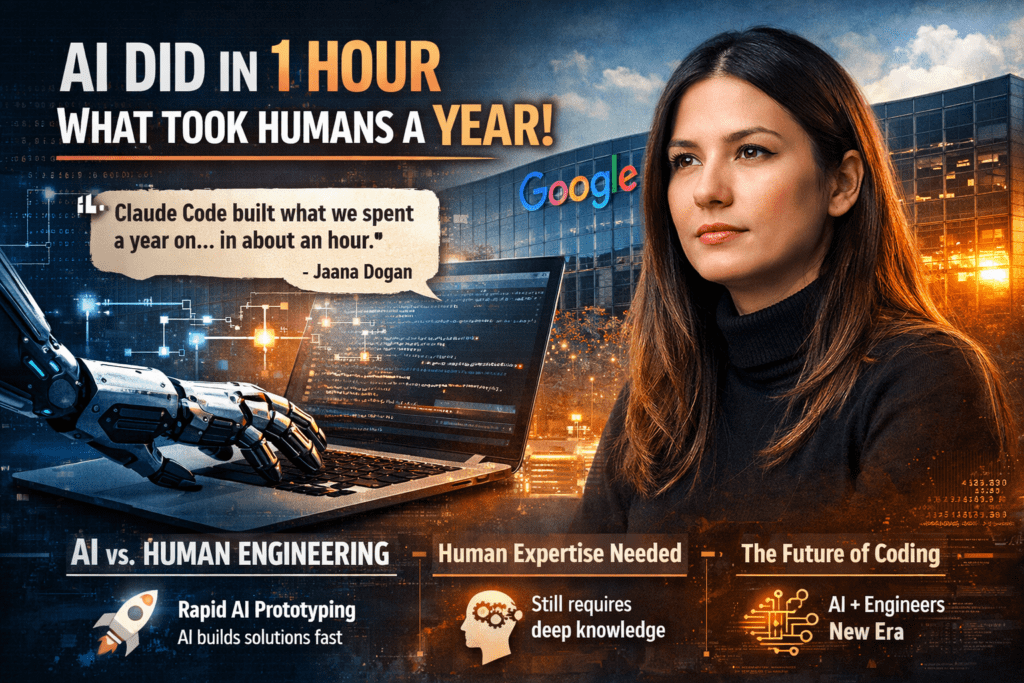
In the fast-moving world of artificial intelligence, one story has captured everyone’s attention: a principal engineer at Google admitted that an AI tool built in one hour what her team had spent nearly a year developing. This statement — made by Jaana Dogan, a senior engineer on Google’s Gemini API team — has sparked widespread discussion about the future of software engineering, coding automation, and AI’s role in tech innovation. ([The Economic Times][1])
Let’s break down the full story — what Dogan said, why it matters, what experts are discussing, and what it means for the future of coding and AI development.
Who Is Jaana Dogan?
Jaana Dogan is a Principal Engineer at Google recognized for her work on developer platforms and AI-driven technologies like the Gemini API. She is respected for her practical experience building complex systems and her willingness to speak openly about tech developments. ([X (formerly Twitter)][2])
Her recent post on X (formerly Twitter) went viral after she discussed a surprising experiment testing Anthropic’s Claude Code, an AI coding assistant created by a competitor. ([X (formerly Twitter)][2])
The Viral Moment: AI Outpaced Human Engineering
In her post, Dogan revealed that she gave Claude Code a high-level description of a challenging technical problem her team had been wrestling with for a year — developing distributed agent orchestrators — without providing detailed proprietary specifications. ([The Indian Express][3])
To her surprise:
Claude Code generated a solution in about one hour that looked very similar to what her team had spent months designing. ([The Indian Express][3])
She wrote, “I’m not joking and this isn’t funny. We’ve been trying to build distributed agent orchestrators at Google since last year… I gave Claude Code a description of the problem, and it generated what we built last year in an hour.” ([The Economic Times][1])
This led to headlines around the world — from Indian Express to Economic Times — highlighting not just the astonishing speed, but the potential change in how AI can speed up development workflows. ([The Economic Times][1])
Why This Story Matters in Tech
The importance of this story goes far beyond a social media post. It touches on several key trends reshaping the technology landscape:
1. AI Is Becoming a Creative Partner — Not Just a Tool
Claude Code didn’t just automate basic tasks — it produced a solution that resembled months of careful code design work. This suggests AI is moving into areas traditionally seen as uniquely human: creating complex technical systems. ([Amar Ujala][4])
This isn’t simply “autocomplete” or routine code generation — it’s conceptual alignment with human engineering decisions.
2. Speed vs Expertise: A New Dynamic
The story makes it clear that AI is not replacing engineers — at least not yet — but significantly changing how they work:
- The AI output was not production-ready and still needed human oversight. ([Amar Ujala][4])
- However, it served as a functional prototype requiring fewer revisions than a conventionally built version.
This highlights a new reality where the speed of idea generation and first drafts could outpace traditional engineering cycles.
3. Team Coordination Technical Skill
Dogan pointed out something very strategic: the bottleneck wasn’t just technical skill — it was alignment among engineers on design choices. In other words, decision-making and teamwork are more important than raw coding ability in this AI-supported age. ([LinkedIn][5])
A LinkedIn post analyzing her comment noted that:
- team size no longer predicts outcomes
- execution and design are more important than organizational structure
- rapid prototyping becomes a significant advantage.
This shifts leadership focus toward decision-making speed and design clarity in engineering teams. ([LinkedIn][5])
Industry Reaction: Buzz, Skepticism, and Reflection
Dogan’s message didn’t just shock — it sparked debate.
AI Supporters Embrace the Shift
Many developers and AI supporters see this as a confirmation of coding agents — tools that can help experts increase their impact. The idea is that small teams with capable AI can outperform larger teams slowed down by bureaucracy and longer decision cycles. ([LinkedIn][5])
Skeptics Warn Against Overhyping
Others caution that:
- AI tools still need to be guided properly with expert input
- outputs may reflect publicly available ideas and design patterns
- real production systems require deep human expertise beyond prototypes.
Dogan herself recognized that years of experience are still necessary to understand trade-offs, long-term reliability, and important patterns in actual products. ([Amar Ujala][4])
Internal Tool Use Clarified
Google has restrictions on using third-party tools like Claude Code for proprietary work. Dogan clarified that this was a public exploratory experiment, not a standard process for Google internal products. ([Amar Ujala][4])
What This Means for Software Engineering
This story provides a practical view of where tech is heading:
AI as First Draft Generator
Engineers will increasingly turn to AI for rapid prototyping, cutting down on time spent on routine structure and scaffolding.
Human Role Shifts Toward Strategy
The role of senior engineers will change:
- defining problems clearly
- validating AI-generated designs
- ensuring long-term maintainability
AI doesn’t replace human creativity — it enhances it.
Skill Sets Will Adjust
Technical careers might focus more on:
- prompt engineering
- model interpretation
- AI tool management
- ethical and architectural judgment
The Broader Trend: AI and Developer Ecosystems
This incident is part of a larger change in the industry:
- coding assistants are not just helpers — they’re partners
- major AI companies like OpenAI, Anthropic, and Google are competing in this area
- developers are reassessing how work is done in large organizations versus small teams
Meta CEO and Microsoft leaders have also weighed in on AI quality discussions, suggesting that the emphasis shouldn’t be on sloppy versus refined, but on how AI integrates with work and creativity. Jaana Dogan noted that negative feelings towards AI often come from burnout with new tech, not necessarily logical criticism. ([Search Engine Journal][6])
Conclusion: A Turning Point?
Jaana Dogan’s viral statement is more than just a headline — it’s a snapshot of the change happening in tech. It highlights:
- the growing capabilities of AI coding tools
- the shifting landscape of software engineering
- the strategic balance between human creativity and machine efficiency
- and the ongoing conversation about what it means to develop tech in the AI era
Whether you’re an engineer, product leader, investor, or tech enthusiast, this story signals a moment of change — AI isn’t just helping to write code anymore — it’s shaping architectural solutions at speed and scale once thought impossible.